
cloud.gov (Fearless)
Delivering language updates, content modernization, and UX-friendly guidelines for consistent tech team documentation and diagrams


At a glance
My roles
Content designer and technical writer
Summary
cloud.gov is a Platform as a Service (PaaS) developed and maintained by the GSA’s Technology Transformation Services (TTS) unit. Its purpose is to help U.S. federal agencies develop, deploy, and scale services in a secure cloud environment.
Collaborated with
-
Product Managers (1)
-
Software Developers (3+)
-
Site Reliability Engineers (1)
Duration
Apr 2024 to Aug 2024 (5 months)
Highlights
-
Complex technical ecosystems translated into usable, accessible documentation
-
Scalable frameworks established for IA and taxonomy
-
GenAI leverage for knowledge management and work flow efficiency
Impact
GenAI prompt engineering accelerated definition creation and reduced manual documentation time by 50% (200+ entries completed in half the projected timeline).
Problems
-
Documentation was fragmented, overly technical, and not accessible to all users
-
No scalable taxonomy to act as a reference point for our 200+ terms and concepts
-
Diagrams were not accessibility compliant or user-friendly
-
No long term plans for governance of documentation and IA standards after contract end
Solutions and process
-
Created and maintained clear, actionable guides for deploying and managing applications, including step-by-step tutorials for setting up environments, configuring services, and troubleshooting issues
-
Developed a comprehensive taxonomy and data dictionary using GenAI-assisted prompt engineering
-
Helped the team rebuild diagrams with accessibility compliance and user comprehension as priorities
-
Delivered sustainable frameworks for Fearless and cloud.gov teams to maintain content long-term
Release strategy
Legacy documentation review
While the legacy documentation pertaining to our release strategy had a lot of useful information, it lacked a cohesive structure and had several knowledge and usability gaps.
Additionally, plain language standards and accessibility standards were not up to par.
Too wordy; confusing jargon

No H1>H2>H3 structure
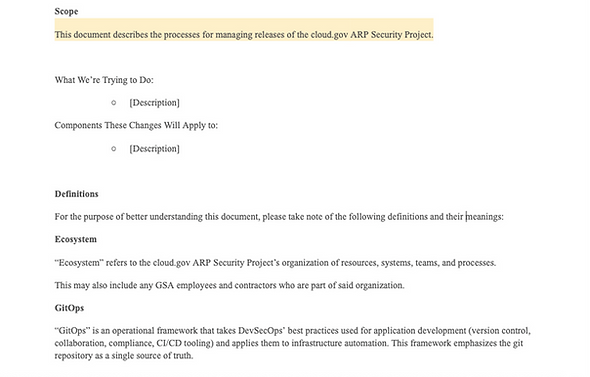
V2 and V3 drafts noting language inconsistencies and knowledge gaps


Collaboration workflows
Over the course of several weeks, I worked closely with devs, engineers, cloud.gov SMEs, and product owners to ensure the document:
-
Included all necessary sections to define new code, explain our strict security/compliance controls, and documented deployment processes
-
Was written in a tone that was appropriate for our intended audience (cloud.gov engineers, compliance leads, technical content writers)
-
Used language familiar to our intended audience
-
Was structured for scannability and navigability
-
Ensured accessibility by making sure all headings followed a logical hierarchy (H1>H2>H3)
-
Was comprehensive via consistent feedback and usability testing on behalf of our devs and engineers
-
Was maintainable via use of modular content that could be updated independently once handed off to cloud.gov’s team
Changes between versions—we had 4 in total


Final artifacts
The result was an efficient, clear, adoption-friendly, and compliant document that was accepted by and integrated into cloud.gov’s release plans.


Creating a data dictionary
Purpose
We were dealing with a lot of technical terms that spanned more than one internal platform and team. As such, I created a taxonomy to act as a reference point for all terms used throughout our diagrams and documents.
The purpose was ultimately to standardize language and provide plain language definitions of ARP Security terms.


Grammar and formatting
It was important to distinguish between common and proper nouns to ensure correct capitalization and spelling. We were dealing with a lot of terms that were standard within engineering (ie, “App container”) and others that were branded services using the same name (ie, “AppContainer).


Prompt engineering
I had 200+ terms to define, and our devs, engineers and cloud.gov SMEs were busy people.
To increase the efficiency of my own work flow, and to save us all some time, I leveraged prompt engineering with GenAI to produce consistent definitions for all terms.


Style guide
Ensuring content consistency and accessibility
Once my contract was winding down, I provided the team with a style guide to ensure the standards I’d put into place were maintained in the interim.
This guide included:
-
Language, grammar, and naming conventions
-
Accessibility-compliant diagrams
-
508 compliance best practices


